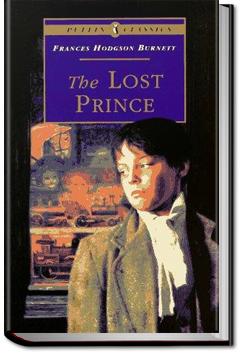
Today is National Read a Book Day, which means....READ! You might not be able to read an entire book today, but it would be great if everyone can take the time to read something lovely. And, as you would know from my previous post, one such lovely book is The Lost Prince by Frances Hodgson Burnett, a lovely but little-known classic that takes place in the 19th century. The Lost Prince is a great story to read before bed.


Let's read some of this wonderful story today. This passage is from near the beginning of the story when Marco and his father are talking about Samavia, the country they are from, and where the Lost Prince is from...


"We are of those who must LIVE for Samavia—working day and night," his father had answered; "denying ourselves, training our bodies and souls, using our brains, learning the things which are best to be done for our people and our country. Even exiles may be Samavian soldiers—I am one, you must be one."
"Are we exiles?" asked Marco.
"Yes," was the answer. "But even if we never set foot on Samavian soil, we must give our lives to it. I have given mine since I was sixteen. I shall give it until I die."
"Have you never lived there?" said Marco.
A strange look shot across his father's face.
"No," he answered, and said no more. Marco watching him, knew he must not ask the question again.
The next words his father said were about the promises. Marco was quite a little fellow at the time, but he understood the solemnity of them, and felt that he was being honored as if he were a man.
"When you are a man, you shall know all you wish to know," Loristan said. "Now you are a child, and your mind must not be burdened. But you must do your part. A child sometimes forgets that words may be dangerous. You must promise never to forget this. Wheresoever you are; if you have playmates, you must remember to be silent about many things. You must not speak of what I do, or of the people who come to see me. You must not mention the things in your life which make it different from the lives of other boys. You must keep in your mind that a secret exists which a chance foolish word might betray. You are a Samavian, and there have been Samavians who have died a thousand deaths rather than betray a secret. You must learn to obey without question, as if you were a soldier. Now you must take your oath of allegiance."
He rose from his seat and went to a corner of the room. He knelt down, turned back the carpet, lifted a plank, and took something from beneath it. It was a sword, and, as he came back to Marco, he drew it out from its sheath. The child's strong, little body stiffened and drew itself up, his large, deep eyes flashed. He was to take his oath of allegiance upon a sword as if he were a man. He did not know that his small hand opened and shut with a fierce understanding grip because those of his blood had for long centuries past carried swords and fought with them.
Loristan gave him the big bared weapon, and stood erect before him.
"Repeat these words after me sentence by sentence!" he commanded.
And as he spoke them Marco echoed each one loudly and clearly.
"The sword in my hand—for Samavia!
"The heart in my breast—for Samavia!
"The swiftness of my sight, the thought of my brain, the life of my life—for Samavia.
"Here grows a man for Samavia.
"God be thanked!"
Then Loristan put his hand on the child's shoulder, and his dark face looked almost fiercely proud.
"From this hour," he said, "you and I are comrades at arms."
And from that day to the one on which he stood beside the broken iron railings of No. 7 Philibert Place, Marco had not forgotten for one hour.


Happy reading!


]

The Lost Prince is one of my favourite books, telling the story of a boy named Marco and his father who are exiles from their homeland in Samavia (a fictional European country in the 1800s). It is a rather Arthurian story (the once and future king!), and like other books by Burnett, includes elements of Eastern mysticism and philosophy. Here is one quote that takes place during a conversation between Marco and his friend The Rat:

From The Lost Prince by Frances Hodgson Burnett (1915)
"'All thinking is part of the Big Thought,' said Marco slowly. "It KNOWS--It KNOWS. And the outside part of us somehow broke the chain that linked us to It. And we are always trying to mend the chain, without knowing it. That is what our thinking is--trying to mend the chain. But we shall find out how to do it sometime."


By our thoughts, whether they be part of our soul, spirit, or nothing more than fleeting ideas arising from our physical form, we are connected to the universe. The force, or the Big Thought spoken of here, that created us all is what we strive to return to. Our thoughts are one with it, but we often do not realize this while we're in a body (as a human being). In mending the chain that links us to the Big Thought (also called the One), we must also break the chains that links us to the material world, so that we are not bound by it and confused by the matter around us, believing it is all that exists. It is about becoming enlightened enough to perceive a higher order of things.
This seems to be a similar theme with other things I've written as of late, but it's not a coincidence! (In a future post I'll write about how the philosophical side of this can be connected to science, in particular, physics.)
Later on, Marco talks about the Law of The One. It is:
"There are a myriad of worlds. There is but One Thought out of which they grew. Its Law is Order which cannot swerve. Its creatures are free to choose. Only they can create Disorder, which in itself is Pain and Woe and Hate and Fear. These they alone can bring forth. The Great One is a Golden Light. It is not remote but near. Hold thyself within its glow and thou wilt behold all things clearly. First, with all thy breathing being, know one thing! That thine own thought--when so thou standest--is one with That which thought the Worlds!"
This is also a very Buddhist/Hindu/Taoist teaching, and the idea of a myriad of worlds is essentially a multiverse of different worlds with different dimensions or laws, all of which arise form the one thought. The One is the force that created all the worlds, all of which are still under its sway. This is also reminiscent of Neoplatonism: all lower planes of existence emerge from the One. We have "Nous" below the One (the Divine Mind), then Soul, and then Body (i.e., the material world). I could go into how the Kabbalah is related to this too, but you can just check out the previous post here.
And the mention of Order is interesting because it is common theme in all these philosophies that the One is a simple undifferentiated being (if it can even be called a "being"), and the worlds that exist below it are more differentiated and thus, can be prone to good or evil, love or hate, etc. It is like a beam of white light being dispersed by a prism: the white light is the One, and the coloured beams arise from it, but are not as pure and simple as the white light, and so can take on different characteristics. Yet still, they are all connected to the One, and it is by remembering this and dwelling in the simplicity of the One that one might mend the chain. We are trying to return to the mode of existence that is above our own, and although we can't do it in this physical form, we still ever strive to do it. Body is ever striving to return to Soul, a simpler and purer plane of existence (if you think of it in terms of dimensions, it is to encompass a higher dimension). And Soul is striving to return to Nous, and Nous to the One. So they are all linked, and so the metaphor of the chain is perfect for representing these different layers of existence and how one might attune oneself to the level of existence above it.
There is also the Law of That Which Creates, which Marco's father told him:
"Let pass through thy mind, my son, only the image thou wouldst desire to see become a truth. Meditate only upon the wish of thy heart--seeing first that it is such as can wrong no man and is not ignoble. Then will it take earthly form and draw near to thee."
This touches upon the power of our thoughts, how what we think draws the object of our thoughts toward us. Of course, it is not as obvious as thinking about getting something and then getting it, but if we attune ourselves to a certain frame of mind, we will more naturally be able to find others who think similarly and be drawn toward those things in the world. If we think badly of someone else, it will only come back to us, for we are also told that "Let him who stretcheth forth his hand to draw the lightning to his brother recall that through his own soul and body will pass the bolt." Thus the common saying that good begets good and evil begets evil.

I wish this book was more well known, because it is an amazing story that should be forever a Classic. And to all those seekers out there, I wish you well in mending the chain...

[Note: the black and white illustrations are from one of the original editions of the book]

Kabir was a mysitc poet who lived in India in the 15th century. He tried to untie people of Hindu, Islamic, Sufi, and other religions together, believing that the unity of a single God that was at the base of all these religions. He was critical of both the Hinduism and Islam and their isolation from others (these were the main religions he tried to unite and that were prevalent in India in his time). He also believed in a more personal spiritual path to understand and feel the Divine for oneself, something that is in everyone and the world. It is a sort of pantheism that connects everything and everyone together.
Here is a quote from one the poems:

From Songs of Kabir (~mid 1400s, translated by Rabindranath Tagore):
"The moon shines in my body, but my blind eyes cannot see it:
The moon is within me, and so is the sun.
The unstruck drum of Eternity is sounded within me; but my deaf ears cannot hear it.
So long as man clamours for the I and the Mine, his works are as naught:
When all love of the I and the Mine is dead, then the work of the Lord is done.
For work has no other aim than the getting of knowledge:
When that comes, the work is put away.
The flower blooms for the fruit: when the fruit comes, the flower withers."


Such a beautiful poem, as are all the others in the book. There's a lot in it, but I wanted to focus on the first part: "The moon shines in my body, but my blind eyes cannot see it." When he says, "the moon", I think it could be any part of the universe which is, at its essence, within you. If the universe is a dynamic entity that is essentially one (a common belief in Eastern religions and philosophies), then you are connected to all other parts of the world. The moon is "within" you, just as you are within the moon. The connection to the moon is especially important because of the influence it has on human bio-rhythms and the Earth (creating tides, etc). We hardly notice the effects of the phases of the moon in our lives, but the moon continues to exert an influence over our well-being, both physical and mental. We have "blind eyes" that cannot perceive the essential oneness of the universe and the forces that connect us to it. We see the moon up in the sky, and do not feel the connection that we have to it and everything else.
So too is the sun within us, the giver of light and life. The principles of male and female are also represented by the sun and moon, and these qualities are within us all. And the "unstruck drum of Eternity" seems to me to be the One, the Tao, Brahman (or Aristotle's "unmoved mover"!), the one being that is the world and also beyond it. This is more panentheism rather than pantheism: pantheism is that God is the world, but panentheism is that the world is in God but that God is also greater than the world.
The next part about the "I" and "Mine" has a distinctively Buddhist flavour. If we continue to think of things as distinct from us, then we will either be in a state of lack or wealth with respect to them. We will "have" the American Girl doll, or we will not have it. And if we don't "have" it, we will (presumably) suffer. Instead, we must learn to see it not as something to gain or lose, but a part of the universe that we are already at one with. We don't need to have things for ourselves, we don't need to possess the world, possess other countries, or other planets and solar systems even! It's not about owning, because anything we own can be taken away. And anything that can be taken away from us has some control over us: we will always be striving to protect our things and strive to get more and more (e.g. "don't touch my American Girl doll!", "I will put it under lock and key!"). And isn't that what so much of our life is focused on in our society? Getting money, getting a car, getting a house, getting an American Girl doll...and even for those who want to gain knowledge, it's about "getting" the best book to do so. With this mindset, we will always be 'clamouring' to get this and that, instead of focusing on what is important.
And what is important, then? Here, it seems that Kabir is saying that the pursuit of knowledge and truth is, and I would agree with him. And based on what he's written elsewhere, I would add that this gaining of the truth is to experience the oneness of the universe and our unity with it. God is the universe, and so to know God, we must experience him through out lives and perceptions, not only grasping him in thought. It is to love the world in its entirety, which might be achieved by the realization (through learning or direct experience) of how we are connection to everything in the universe. This isn't just mysticism, but has correspondences to physics as well, such as the entanglement of particles and the equivalence of mass and energy (see The Tao of Physics, in particular).
And so we must go beyond seeing the world as opposites and separate beings to perceive what underlies it all. Perk your mind and ears to hear that unstruck drum of Eternity...


In this post, I'll look at 3 more possibilities for other worlds. The first 3 were in the previous post that are worth reading first so you know what on Earth is going on (actually, its not on Earth at all).
So here are three more possibilities for other worlds:

4) Parallel Worlds from Time Travel
Time travel works differently depending on your theory of time. By theory of time, I mean how time "works". Regardless of how you do it (via relativity, a wormhole, a TARDIS, etc.), what is more fundamental is the nature of time itself. Some features of time could be that there is or is not an instant in time that you can call the present, that time had a beginning/end or does not, that you can only change things in the past that will not cause too much of a paradox, that all time travel is determined, that time itself is or is not determined...and so on.
What concerns us here is whether parallel worlds will be created because of time travel. Imagine if you could create a world just by travelling through time! (Ok, perhaps it isn't fair to say "just" travelling through time, unless you're the Doctor). In the scenario that the past is determined but the future is not, then if someone travels to the past, then we have a problem. Everything is set in our determined past except for the time traveler going there, because from the point of view of the time in the past, they are in the future, which is not yet set. One possibility is that this creates a parallel world, one that has the same past as the "regular" world until the point in time that the time traveler goes back to, and at this point, time expels him into a parallel world to keep the regular timeline intact, like so:

The parallel universe will start out very similar to the regular one, but it will diverge to become more and more different due to the effects of the time traveler. So after some time, they could be completely different worlds, with different people and histories, different societies and technologies.
If people time travel enough, there would be many parallel worlds, some similar, some vastly different, and the parallel worlds could spurt parallel worlds which could spurt more parallel worlds so that you could get a mess like this:

Here, the bottom line is the regular timeline which fractures to many different worlds because of those clever time travelers. So time becomes even more relative than one would suppose just with the special theory of relativity: you can't even say that these worlds have the same time at the start since the parallel world is created in the past of one timeline (the original one) and the present of another (the offshoot). That's worth thinking about for a moment.

5) Quantum Mechanics (QM)
In QM, what can happen, does. At the subatomic scale, things don't happen in the relatively predictable manner that they do in the world we are used to. Things can be in more than one place at the same time, particles at opposite ends of the universe can be tied together faster than the speed of light, and it is impossible to accurately know both the position and momentum of a particle.
-fantasy castlesOne interpretation of how QM works is the Many Worlds theory. In this scenario, each quantum mechanical possibility occurs in a different world. This is in contrast with the more common Copenhagen Interpretation. In the Copenhagen Interpretation, particles exist in many states at once, but when they are observed (by a person or equipment that takes a measurement) the many states collapse into one, known as the "collapse" of the wavefunction. However, another interpretation is the Many Worlds theory introduced by Hugh Everett, in which every quantum mechanical possibility happens, but each occurs in a different world. So everything happens, and there are nearly infinite possibilities! So think about every possible universe, those that are only a little different to ours (e.g., one in which your favourite colour is red instead of purple) and ones that have entirely different planets, solar systems, and galaxies.
Galadriel in The Hobbit: An Unexpected Journey. Which I saw opening night last night. And just...oh my. Wonderful. Truly wonderful.To tell you the truth, when people say that there infinite number of "you"s in parallel universes, the very first thing I think of is: "So there is a world where I am an elf queen in Middle Earth with magic powers?" Um...yes. I guess. If that magic follows the physical laws (see 6) below for universes with other physical laws). But whether it is really "me" is another matter entirely. If you believe that you have a soul, or anything beyond the physical matter that makes up your body, then you'd have to say that unless your soul is also duplicated (something QM doesn't tell us about), then it is not you, but just a being that has a similar body to you.
Another aspect of many worlds in quantum mechanics are the creations of universes. This can be seen analogously to virtual particles. Virtual particles pop in and out of existence in the vacuum of space, being created and, most often, destroyed by annihilating with their antiparticle (for example, an anti-election is a positron, which is identical to an electron except for the fact that it has a positive charge).
Likewise with universes, embryonic universes pop into existence in the vacuum, and although most just get "swallowed up" again, some, like ours, grow to become an actual universe. It seems to me that it's arrogant to assume that our universe was the only special one to develop into a universe: why shouldn't others do the same? Here are our other worlds, and although they may be entirely separate "bubbles", it may be possible with advanced technology or magic to access them.

6) String Theory
String theory is an elegant attempt of theoretical physicists to find a theory of everything, the goal being to unite quantum mechanics (which describes microscopic objects) and general relativity (which describes macroscopic objects). The basic idea of string theory is that at the most fundamental level, matter is made of strings that vibrate. These are one-dimensional strings, and their properties are determined by their vibrations. There are many different versions of string theory, but they all involves extra dimensions, 10, in fact (though with M-theory, a kind of string theory that unites many of the different ones with 10 dimensions, has 11). They often say that the other 7 dimensions are "curled up" so that we don't perceive them and seem to be living in a 3-D world (not including time dimensions).
However, it is also possible that these higher dimensions are larger, and that we are living in a higher dimensional universe (like those mentioned under "Other dimensions" in Part 1). If that's the case, then we can be living in a higher dimensional multiverse that may have higher worlds that encompass more dimensions, though it is also possible that there are other worlds like ours of the same dimension that are "branes" in the "bulk" of the multiverse (I didn't make those terms up--check if you don't believe me!).
So we may be a 3-D brane hovering within the 11-D bulk, and there may be other branes of other dimensions, say, a 5-D brane or a 7-D one, that are also hovering in the bulk. These branes can collide, merge, and other universes can be created by the collision or fission of branes.
These worlds can have different physical laws, and because of some having higher dimensions, things would be very different to our 3-dimensional world. If we traveled to them, we would perceive them all as 3-D worlds because we can't sense higher dimensions directly, but there are other ways in which we could detect them scientifically (e.g. by the "imprints" of higher dimensional objects talked about in Part 1).

10 Mind Blowing Implications of Multiverse Theory

So there we have our other worlds. Although we may not find one in a magical wardrobe, we may one day find ways of accessing these worlds and becoming multiverse travelers, or perhaps even Soul Wanderers. This may be possible through science or more spiritual means, but I think that in order to access something like this, we will have to use both in harmony with each other.



I've been meaning to do this post for a long time, given my extensive use of other worlds in my writing, so here it is. Other worlds are common in fantasy and science-fiction, but they actually have quite a solid basis in physics as well. Here, I'll talk about "other worlds" as other universes, not just other planets within our own universe, but places that are not directly connected to us in space and time. Think The Golden Compass, Alice in Wonderland, Narnia, and hundreds of sci-fi books that I don't know about.

People have thought about other worlds for centuries. The idea of spirit realms, Heaven and Hell, and purgatory were commonly held beliefs even in times B.C. Even a multiverse was posited by Leucippus, the ancient Greek philosopher who also posited atoms.
There are many different options for other worlds, so I'll go through them all:

1) Other dimensions
Having another one (or two, or three...) spatial dimension could cause worlds of different dimensions to be separated. We live in a world with three visible spatial dimensions: things are 3-D in our universe, not flat (2-D) or linear (1-D). I say "visible spatial dimensions" because it is possible that there are tiny dimensions that we can't see. They could be curled up, like so:

Now, I admit this picture is not self-explanatory, so let me explain. Say you live in a 2-D universe. It so happens to be that flat sheet in the picture (the plane below the loops). At every point in this plane, however, there is another dimension curled up (those circles). Here it is shown as going up into the third dimension, but in our world, the "sheet" would be our 3-dimensional universe. These little curls are a higher fourth spatial dimension, which, assuming they are very VERY small, are not visible or traceable to us. Though perhaps with better technology, we will someday trace them (I read about this in Lisa Randall's Warped Passages, which is a really good book that is worth the read).
Another possibility for other dimensions are dimensions above our three dimensions. Our 3-D world is embedded in a higher dimensional "bulk". You can't imagine the higher dimensions, since we are 3-dimensional beings, but we can see what this would be like with an analogy. A 2-D world within a 3-D world would perceive a 3-D sphere passing through it as a series of different-sized discs as seen in the diagram on the right. Likewise, if a hypersphere (4-D sphere) passed through our universe, we would see it a series of different-sized spheres. We would see projections of the higher dimension, but not the higher dimensional object itself.
Now, the curled up dimensions doesn't really relate to other worlds, unless there are super tiny worlds that exist in the curled up dimensions, but if we live in a higher dimensional space, then there are many possibilities for other worlds. It is like those Russian dolls: we are the little doll, and are inside a larger doll (which represents a 4th spacial dimension) and that is inside an even larger doll (5-D), and so on. So there are worlds in worlds in worlds, and you would only be able to perceive the worlds that are of the same dimension as you or lower (we are 3-D so can perceive things that are 2-D, like flat things, or 1-D, like lines), unless you are somehow a higher dimensional creature trapped in a lower dimensional world (*story idea*). The way we'd know about the higher worlds could be through the projections mentioned above, or perhaps, if our soul/spirit/mind is not bound by the 3 spatial dimensions around us, it could be aware of the higher dimensional reality around it, though when it is ensouled in a body, it cannot perceive them. But this ties into our next possibility for other worlds...

2) Higher spiritual planes
This follows the same general idea as the higher physical dimensions. Instead of having higher physical dimensions, there are higher spiritual dimensions. I'm not just making this up out of nothing, for we have good reasons to believe that there are higher levels of existence (and lower). This appears in almost every religion and esoteric tradition, such as in the Kabbalah, Buddhism, Western occultism, and more. People have even had experiences travelling there (e.g. astral projection), and it is thought by many that after you die, your soul "gravitates" to the plane that corresponds to its spiritual enlightenment.
Let's look at the Kabbalah as an example (see this amazing book for the metaphysics of the Kabbalah). The Kabbalistic tree of life is this strange-looking diagram that would only look like a tree to a poet, but let's pretend it really does look like a tree for the moment:


Each sphere is a sephirot, and they are each labelled by different Hebrew words. Keter is the crown, from which all the others emanate. Binah and Hokmah are the male and female principles, and Da'at is knowledge. There are many interpretations about what each sphere stands for, and they are not mutually exclusive: it's supposed to have many meanings. Each sphere, from Malkut (the lowest) to Keter (the highest) corresponds to a different level of enlightenment/state of consciousness. During a spiritual seeker's development, they will progress up the sephirots to go from the more impulsive animal nature to a spiritual being. This can certainly be seen as different worlds, where everyone in a lower level of enlightenment is in a lower world, unable to perceive the higher reality of existence, and those above encompass more worlds, as they are beings of a higher spiritual dimension.
The Kabbalistic tree pictured above is actually one of four. These four are called Assiah, Yetzirah, Beriah, and Atziluth (going from lowest to highest). They are all interlaced to be part of one enormous tree of life with Atziluth's Keter at the top:

As you can see, there is some overlap, so, for example, the Keter of Assiah is the Tiferet of Yetzirah. Every sephirot emanated from the Keter at the top, and are all contained within it (this is similar to dimensions, but is all these worlds aren't physical. In fact, only Assiah, the physical universe that we live in, is physical). The higher worlds are spiritual worlds, and these can only be perceived by someone of that level of enlightenment. There may be traces of these higher worlds, and indeed, within our own souls, that are perceptible, but they are like projections of higher dimensions into lower ones. It is also possible that different universes exist at different levels in the Kabbalistic tree of life. Ours is (most likely) somewhere in Assiah, but there may be many more universes at the levels of higher sephirots within Assiah and the higher worlds as well.
The Kabbalah's a lot more detailed and complex than that, so I will do another post sometime just on this.

3) Plato's Cave (This is a hint for the sequel to Aizai the Forgotten!)
If you're not familiar with Plato's Allegory of the Cave, here is a little summary of what it is:
There are prisoners in a cave sitting chained to the spot so that they cannot turn their heads and can only look at one wall. Behind them is a fire and a roadway in front of it where unchained people walk by. They carry various objects that project shadows onto the wall that the prisoners see. These shadows comprise the whole world of the prisoners: they know nothing more to exist than the shadows, and make a game out of predicting what the shadows will be and what they will do.
Suppose that one prisoner were released from his bonds and is shown the fire so he can see that his reality is really just projections of physical 3-dimensional objects onto a wall . The prisoner is amazed and enlightened at this knowledge. The fire burns his eyes, but slowly, he gets used to its brightness.
The prisoner is then brought out of the cave (in stages to accustom him to it) into the full light of the sun. When he can look at the Sun and the world around him without being blinded, he sees the world for what it really is. This is even more profound than the blaze of the fire, and he has at last arrived at the more "real" world that the world in the cave was merely a shadow of.

Ignoring various physical and ethical factors that make this improbable (e.g., how do the prisoners eat? Wouldn't they be muscle-less and weak-boned flubber from sitting so long?), this allegory is about the enlightenment that people can gain by means of philosophy. This is really related to 2), but I thought that it was worth putting separately. The world of shadows upon the wall is the least "real", and is the lowest level of spiritual existence. The world of the fire is a bit higher, and from it, the prisoner can see the shadows for what they really are: only shadows, not real things in themselves. And finally, the light of the Sun is the enlightenment one obtains upon becoming a true philosopher and seeing things as they really are.
sandcastleWe live in a cave, unable to perceive what the world really is at a fundamental level. Even if some people are out of the cave that normal people live in, there are really caves in caves, and when one is in a higher level of existence, a higher world, they are in the cave of an even greater world. How far does this go? Perhaps it's impossible to know unless you're in the highest world. Get to the biggest Russian doll and look outside to see if there's any more. If you see wood, then you're not in the highest spiritual plane. If not, then you may be--or you're just inside an enormous doll :)


~~~~*~~~~
In Part 2 (coming later in June), we'll look at other worlds that result from time travel, and other worlds from physics (quantum mechanics and string theory).

In case you're wondering, I said "philosophy" in the title instead of "science" for two reasons.
1) Because people don't think philosophy is as good as it really is, or they mistake it with mysticism or something (not that there's anything wrong with mysticism). There is a lot of metaphysics in this anyway, especially Plato's cave, so it's legitimate.
2) Science really is philosophy, as you can see in my Natural Philosophy and Science post.

Stay tuned for the next post! You can sign up for email alerts in the box to the right of the page under "Follow by Email".


"A Soul Wanderer never knows. He wanders; he makes his own path through the
heights of the universe."

-Sio Larwick


Follow Me on Pinterest

Mary-Jean's books

The Printer's Devil
The Crystal Cave
The Picture of Dorian Gray
The Lost Prince
The Fellowship of the Ring
The Hobbit
Rise of the Darklings
The Fire King
Clockwork Angel
Jane Eyre
Wuthering Heights
The Lost World
Around the World in Eighty Days
The Sum of All Men
Brotherhood of the Wolf
Wizardborn
The Lair of Bones
Sons of the Oak
Worldbinder
The Wyrmling Horde


Mary-Jean Harris's favorite books »
Powered by Blogger.